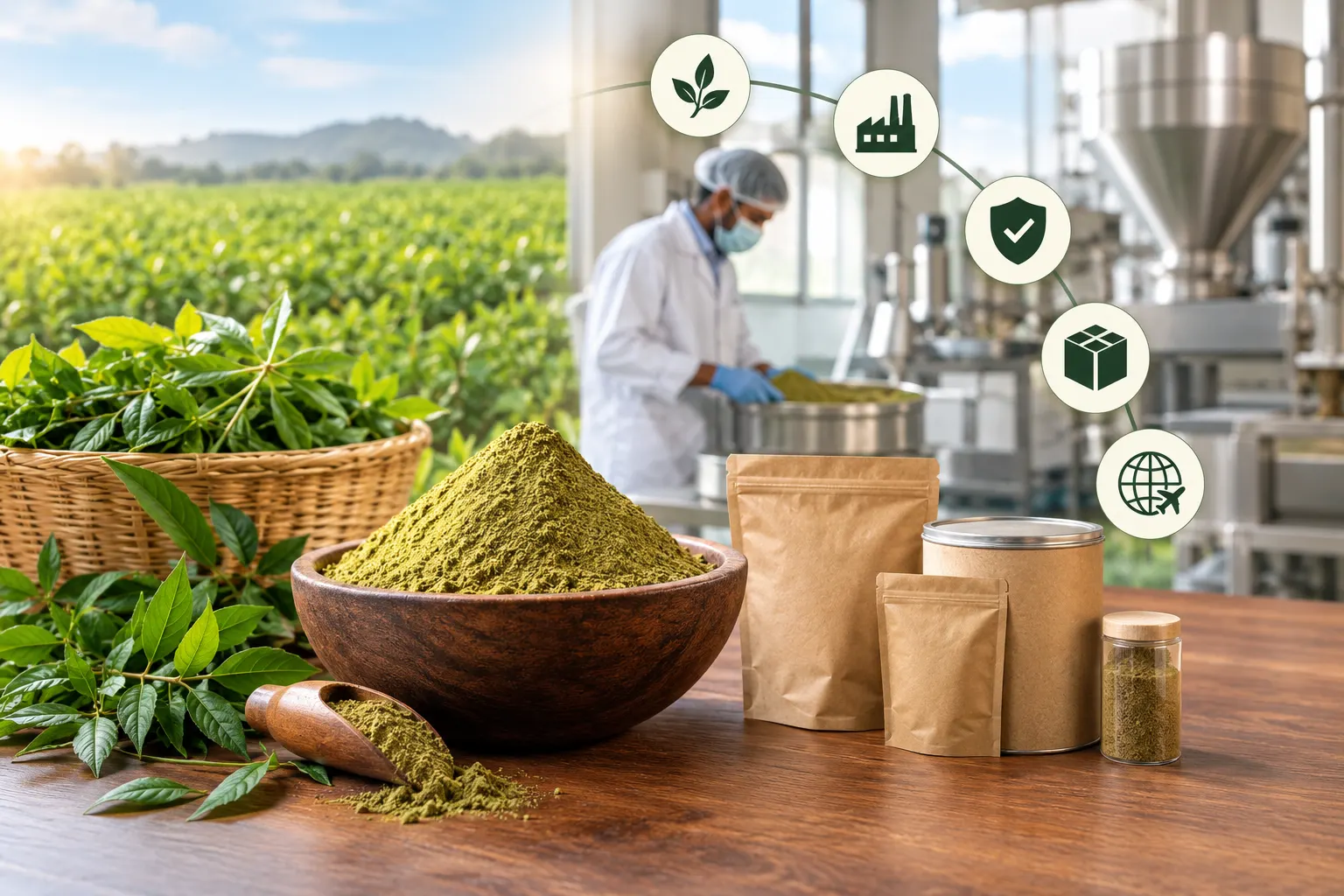
India has a well-established henna industry, with Rajasthan being particularly important for henna cultivation and processing. Sojat, Rajasthan, is widely associated with henna production and is home to manufacturers and suppliers serving both domestic and international markets.
However, simply choosing a manufacturer because they offer a low price or claim to supply “premium henna” may not be enough.
A reliable henna manufacturer should be able to demonstrate consistent sourcing, controlled processing, quality assurance, suitable packaging, dependable bulk supply, and clear communication.
If you are currently searching for a henna manufacturer in India, here are the key factors you should evaluate before placing a commercial order.
The first thing to understand is where the manufacturer sources its henna.
Raw-material sourcing can influence the consistency and characteristics of the finished powder. A manufacturer should be able to provide clear information about the origin of its henna and how the raw material moves through the production process.
Sojat in Rajasthan has a long-standing association with henna cultivation and processing. However, geographic origin alone should not be treated as proof of quality.
Ask the manufacturer:
A manufacturer that can clearly explain its supply chain gives commercial buyers greater visibility into what they are purchasing.
The manufacturing process is another important factor when selecting a henna supplier.
Henna leaves need to go through several stages before becoming a finished powder. These can include harvesting, drying, grinding, filtering, quality inspection, and packaging.
The objective is to maintain the desired characteristics of the powder while minimizing contamination and inconsistencies during processing.
For example, MaruHenna describes a farm-to-powder process involving cultivation, harvesting, drying, fine grinding, and hygienic packaging.
Before working with a manufacturer, ask about:
A transparent manufacturing process can help buyers understand how the supplier maintains product consistency.
For commercial buyers, consistency can be just as important as the initial quality of the product.
A wholesaler or cosmetic brand may receive multiple orders from the same manufacturer over several months. If the characteristics of the powder change significantly from batch to batch, it can create problems for the business and its customers.
Important characteristics to evaluate include:
Do not evaluate a manufacturer solely on one sample.
If possible, request representative samples and compare them before committing to a larger order. Businesses that intend to place repeat orders should also discuss how the manufacturer manages batch-to-batch consistency.
A professional manufacturer should have a defined quality-control process rather than relying only on visual inspection.
Quality control may involve checking factors such as purity, freshness, texture, moisture, packaging integrity, and other product specifications relevant to the intended application.
MaruHenna states that its production involves inspection for factors including purity, freshness, texture consistency, moisture control, and packaging quality.
As a buyer, ask:
What quality checks are performed before the product is dispatched?
Depending on the product and market, you may also need product specifications, batch information, testing information, or a Certificate of Analysis where applicable.
The exact documentation required can vary according to the destination country, product category, and intended use.
A manufacturer may provide excellent samples but still be unsuitable for a business that requires large or recurring quantities.
Before placing an order, determine whether the supplier can meet your expected volume.
Consider:
For example, MaruHenna offers bulk packaging and supply options ranging from smaller commercial quantities to larger orders, including wholesale and export requirements.
The important point is to choose a manufacturer whose supply capacity matches your business requirements—not simply the supplier offering the lowest initial quotation.
If you are launching your own henna brand, manufacturing capability is only one part of the requirement.
You may also need:
A manufacturer with private-label capabilities can simplify the process of developing and scaling your own product line.
MaruHenna provides OEM and private-label support, including customized branding and packaging solutions for business customers.
Before selecting a private-label manufacturer, ask exactly what services are included and what requirements apply to minimum order quantities, artwork, packaging, labeling, and production timelines.
Good-quality henna also needs appropriate packaging.
Henna powder can be affected by environmental conditions such as moisture, heat, air exposure, and unsuitable storage. Packaging therefore becomes especially important when the product is being transported over long distances or stored for extended periods.
For B2B buyers, ask about:
A manufacturer serving both domestic and international customers should be able to discuss packaging according to the intended market.
MaruHenna offers retail, wholesale, private-label, and export packaging solutions, with options designed for different business requirements.
If you are an international buyer, selecting a manufacturer involves more than product quality.
You may also need assistance with:
Documentation requirements vary between countries, so buyers should confirm the exact requirements applicable to their market.
A manufacturer experienced in international supply can make communication and shipment coordination more straightforward.
MaruHenna provides export-oriented packaging, documentation assistance, and international logistics support for global business customers.
Supplier communication is often overlooked during procurement.
However, once you start placing regular orders, communication becomes an important part of the business relationship.
A reliable manufacturer should be able to answer practical questions about:
Pay attention to how clearly the manufacturer responds before placing your first large order.
If basic questions are difficult to get answered before the sale, managing a long-term supply relationship may become more difficult later.
Price is obviously important in B2B purchasing, but it should not be the only deciding factor.
Suppose one supplier offers a lower price per kilogram but provides inconsistent quality, unreliable delivery, or limited packaging options.
The apparent cost saving may disappear when you consider:
For commercial buyers, supplier value is better considered as a combination of:
Quality + Consistency + Supply Reliability + Service + Price
A slightly different price can be reasonable when the supplier provides stronger overall reliability and better support for your business.
One of the simplest ways to evaluate a manufacturer is to request a sample.
Do not immediately judge the manufacturer based on the packaging or marketing material.
Evaluate the actual product.
Depending on your intended application, you may assess:
For B2B buyers, sample evaluation should ideally be followed by a discussion about specifications and the expected characteristics of future commercial batches.
This helps establish expectations before the first large order.
Different buyers have different requirements.
A salon may need a different packaging format and quantity from a cosmetic brand.
A distributor may prioritize bulk availability and pricing, while an international private-label brand may focus more heavily on customized packaging, documentation, and export support.
Before selecting a supplier, clearly communicate:
What are you buying?
How much do you need?
Who is your target customer?
Where will the product be sold?
Do you require private labeling?
What packaging do you need?
How frequently will you reorder?
The right manufacturer should be able to understand these requirements and explain how it can support them.
Sojat in Rajasthan is closely associated with India's henna industry and has an established ecosystem around henna cultivation, processing, and supply.
For buyers looking for Indian henna, sourcing from a manufacturer located close to the production region can provide greater visibility into the raw-material supply chain.
However, buyers should still evaluate the individual manufacturer's sourcing practices, processing systems, quality controls, packaging, and supply capabilities.
“Made in Sojat” should be a starting point for evaluation—not the only criterion.
For businesses looking for a henna manufacturer in India, MaruHenna operates from Sojat, Rajasthan and supplies natural henna for retail, wholesale, private-label, and export requirements.
The company states that its henna is sourced from Sojat and processed through controlled stages including cultivation, harvesting, drying, fine grinding, and hygienic packaging.
Its B2B solutions include:
MaruHenna's packaging and supply options are designed for distributors, retailers, cosmetic brands, private-label businesses, and international buyers.
For businesses planning a new henna product line or looking for a long-term supplier, buyers can discuss their required quantity, packaging format, private-label requirements, and destination market directly with the manufacturer.
Before finalizing your supplier, use this quick checklist:
The answers to these questions can help you distinguish between a basic supplier and a manufacturer capable of supporting a long-term commercial relationship.
Choosing a reliable henna manufacturer in India requires more than comparing prices or searching for the supplier with the most attractive packaging.
A proper evaluation should cover the complete supply chain—from raw-material sourcing and manufacturing to quality control, packaging, bulk capacity, private labeling, documentation, and delivery support.
For wholesalers, distributors, salons, cosmetic brands, retailers, and international buyers, the goal should be to find a manufacturer that can provide consistent products and dependable supply as the business grows.
If you are sourcing natural henna from India, start by requesting samples, understanding the manufacturer's process, verifying commercial capabilities, and clearly communicating your requirements before committing to a large order.
For businesses looking for natural henna sourced from Sojat, Rajasthan, along with bulk, private-label, and export supply solutions, MaruHenna provides manufacturing and supply options for domestic and international buyers.
Looking for a reliable henna manufacturer in India? Contact MaruHenna to discuss your bulk, wholesale, private-label, or export requirements.
Look for transparent sourcing, consistent product quality, controlled processing, quality assurance, suitable packaging, reliable bulk supply, clear documentation, and the ability to support your specific business requirements.
Sojat is an established henna-producing region in Rajasthan. However, commercial buyers should evaluate the individual manufacturer's sourcing, processing, quality control, packaging, and supply capabilities rather than relying only on geographic origin.
Yes. Many Indian manufacturers supply henna directly to wholesalers, distributors, retailers, salons, cosmetic brands, private-label businesses, and international buyers.
Some manufacturers provide OEM and private-label services, including customized branding and packaging. Requirements such as MOQ, packaging format, artwork, and production timelines should be confirmed with the manufacturer.
Minimum order quantities vary by manufacturer and product. Commercial suppliers may offer quantities ranging from smaller wholesale orders to several hundred kilograms or metric-ton quantities.
Yes, manufacturers and exporters in India can supply international markets. However, documentation, labeling, packaging, testing, and import requirements can vary depending on the destination country and product category.
Request a representative sample and evaluate the powder's texture, fineness, cleanliness, aroma, application characteristics, packaging, and consistency. Also discuss product specifications and commercial requirements before approving a large order.
Businesses need predictable product characteristics across repeat orders. Significant changes between batches can affect manufacturing, packaging, customer experience, and brand consistency.
Yes. MaruHenna offers bulk and wholesale supply solutions for distributors, retailers, cosmetic brands, salons, and international business customers.
Yes. MaruHenna provides OEM and private-label support, including customized branding and packaging solutions for business customers.
MaruHenna states that its natural henna is sourced from Sojat, Rajasthan, India.
Yes. MaruHenna provides export-oriented packaging and international supply support for global business customers. Specific documentation and shipment requirements should be confirmed according to the destination market