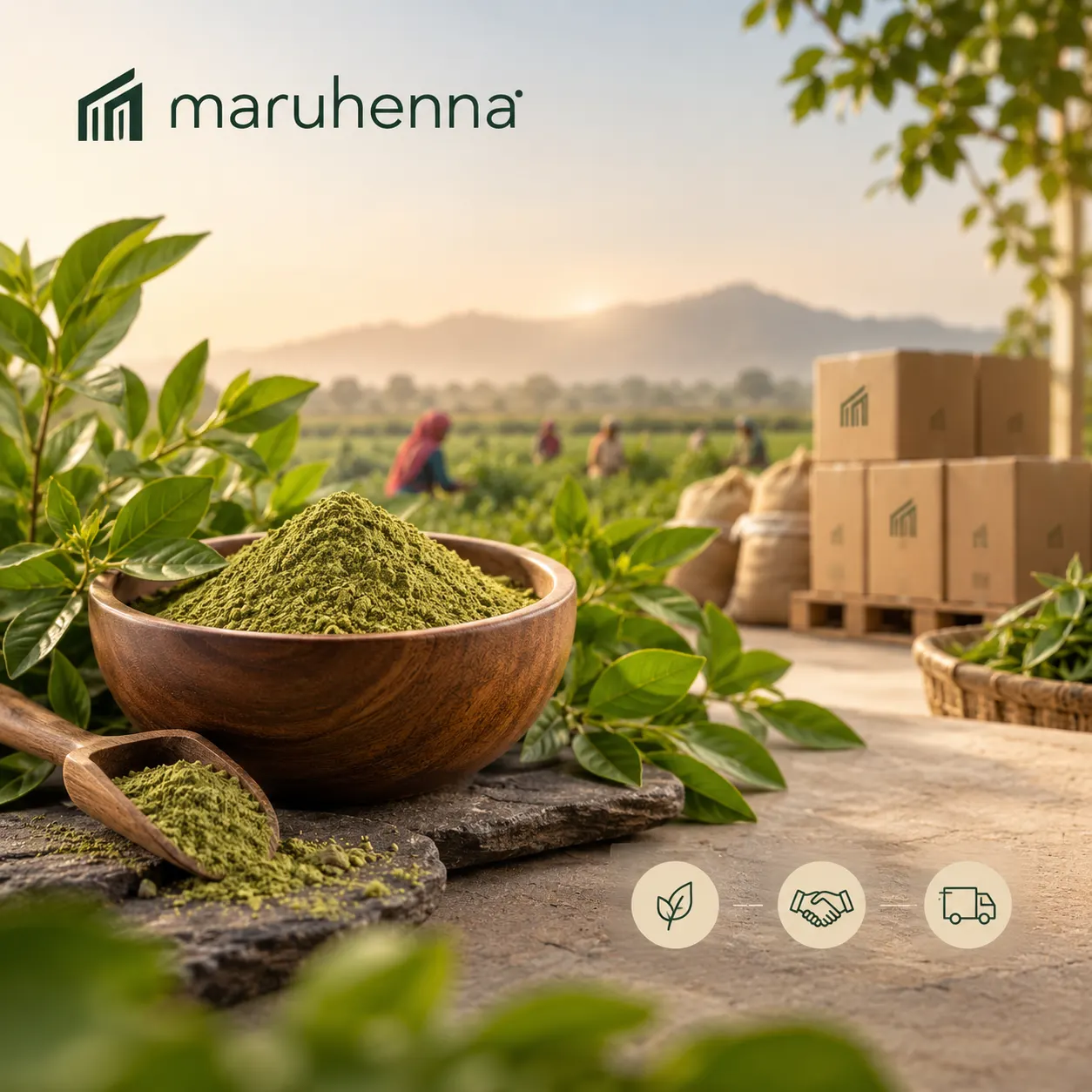
Buying henna powder in bulk is very different from purchasing a small retail pack for personal use. For a wholesaler, retailer, salon, cosmetic brand, distributor, manufacturer, importer or exporter, choosing a henna powder supplier involves much more than comparing the price per kilogram. Product specifications, botanical identity, sourcing, processing, powder fineness, batch consistency, packaging, minimum order quantity, documentation and supply capacity can all affect the value of a supplier.
A low bulk price may look attractive initially, but it does not necessarily mean the supplier offers the best overall value. If the quality varies between batches, packaging is unsuitable, deliveries are delayed or the supplier cannot support repeat orders, the apparent saving can quickly disappear.
The better approach is to evaluate a henna supplier systematically before committing to a large order.
This guide explains how to choose a reliable henna powder supplier for wholesale and bulk buying, what questions to ask before ordering, what factors to compare and which warning signs to consider.
Before placing a wholesale or bulk order, evaluate the supplier across these areas:
A supplier that performs well across these areas is generally worth evaluating more closely than one selected solely because it offers the lowest price.
Henna is a botanical product, and the characteristics of the finished powder can be influenced by several stages of the supply chain.
These may include:
For a personal buyer, differences may become noticeable through texture, preparation or application.
For a business, the consequences can be much greater.
A retailer may need a product that provides a consistent customer experience. A salon may depend on predictable preparation characteristics. A cosmetic brand may require reasonably consistent raw material for its formulation or production process. A distributor may need confidence that future shipments will meet the specifications established by earlier orders.
This is why supplier consistency is part of product quality for many B2B buyers.
The objective is not simply to find a supplier that can deliver one good shipment. It is to identify a supplier capable of providing a suitable product and dependable commercial support over time.
Before contacting suppliers, establish exactly what you need.
The right supplier for a salon may not be the right supplier for a cosmetic manufacturer, private-label brand or international distributor.
Henna powder may be purchased for applications such as:
Your intended application can influence the specifications, packaging and documentation you need.
Your purchasing requirement could range from a relatively small wholesale order to hundreds of kilograms or tonne-level commercial quantities.
Before requesting quotations, consider:
A supplier should be able to explain what quantities and packaging formats it can support.
When purchasing natural henna, start with a basic question:
What botanical material is actually being supplied?
Natural henna comes from the plant Lawsonia inermis. Buyers should look for clear product information rather than relying entirely on promotional descriptions.
Terms such as:
do not, by themselves, provide enough information to evaluate a commercial raw material.
Ask the supplier about the product's botanical identity, ingredients and intended application.
For cosmetic brands, manufacturers and private-label businesses, this information becomes particularly important because the henna may eventually form part of another product or be sold under a separate brand.
Source transparency is another important consideration when evaluating a henna supplier in India.
Henna cultivation and production are associated with particular regions, and the characteristics of the raw material can influence the finished product.
Maru Henna identifies its henna as being sourced from Sojat, Rajasthan, a region associated with henna cultivation and production.
For a commercial buyer, understanding the source can provide greater visibility into the supply chain.
Ask potential suppliers:
A supplier that can clearly explain its sourcing and processing gives a buyer more information with which to evaluate the product.
The manufacturing process can be an important part of supplier evaluation.
A supplier should be able to explain, at an appropriate level, how raw henna leaves become the finished powder being supplied.
Depending on the operation, processing may involve:
The objective is not to assume that one particular processing method is automatically superior.
Instead, buyers should understand whether the supplier has a defined process and whether that process is capable of producing a product appropriate for the intended application.
Maru Henna describes a process involving cultivation and sourcing, harvesting, drying, fine grinding and hygienic packaging.
When comparing another henna powder manufacturer, ask the supplier to explain the stages that are relevant to your requirements.
Powder fineness is an important practical consideration when buying henna in bulk.
A suitably processed powder can be easier to mix and handle, depending on its intended application.
For commercial buyers, consistency is particularly important.
If one shipment has a noticeably different texture from another, it may affect:
Before placing a large order, ask about:
If samples are available, evaluate a representative sample before committing to a much larger purchase.
A reliable supplier should be able to explain how the product is specified and evaluated.
For buyers whose application depends on henna's natural colouring properties, it can also be useful to ask whether the supplier maintains relevant specifications for the product and whether testing information is available where applicable.
One naturally occurring compound associated with henna's dyeing properties is lawsone.
However, buyers should avoid judging a supplier solely on a single number or marketing statement. The appropriate specification depends on the intended application, product type and market requirements.
Instead, ask:
The key objective is to understand what the supplier actually controls and how those controls relate to your intended use.
This is one of the most important considerations for a commercial buyer.
A supplier may provide an excellent first shipment. The more important question is whether future orders can maintain comparable characteristics.
Consistency may matter to:
Customers purchasing the same product repeatedly generally expect a similar product experience.
Professionals may need predictable preparation and application characteristics.
Manufacturing processes can depend on reasonably consistent raw-material characteristics.
Distributors need confidence that future inventory will meet the expectations established by previous shipments.
International buyers may work with agreed specifications and market-specific requirements.
Before selecting a long-term bulk henna supplier, ask how batch consistency is monitored and how variations are handled.
If possible, test the product before scaling your purchase.
A sample or smaller commercial order can help you evaluate:
For larger commercial requirements, the sample should ideally represent the type of product you expect to receive in production orders.
A sensible procurement process is:
Supplier shortlist → product specifications → sample → evaluation → trial order → larger order → repeat-order monitoring
This approach can reduce the risk of committing significant capital before the supplier has been properly evaluated.
Quality assurance should be more than a phrase such as "premium quality."
Ask the supplier how quality is monitored during production.
Depending on the product and application, relevant considerations may include:
Maru Henna describes quality checks relating to factors such as purity, freshness, texture consistency, moisture control and packaging quality.
When comparing suppliers, focus on the actual processes behind their quality claims.
The useful question is not:
"Do you provide premium quality?"
A better question is:
"What quality checks do you perform, and how do you maintain consistency between batches?"
Packaging is an important part of bulk procurement.
It can affect:
The appropriate format depends on your business model.
A retailer may require consumer-ready packs, while a manufacturer or distributor may prefer larger bulk packaging.
If you are building a private-label brand, packaging requirements can be even more specific.
Before ordering, clarify:
Maru Henna states that it provides retail, wholesale, private-label and export packaging solutions, including bulk and custom packaging options.
Minimum order quantity can significantly affect whether a supplier is suitable for your business.
A new private-label brand may need a smaller initial quantity than an established distributor.
Before placing an order, clarify:
Do not assume that the supplier's standard retail quantity is also its commercial minimum.
Always confirm current MOQ requirements directly with the supplier.
Price per kilogram matters, but it should not be the only measurement.
Consider two hypothetical suppliers.
Supplier A offers a lower price but has inconsistent batches, limited packaging options and uncertain delivery times.
Supplier B costs slightly more but provides:
Supplier B may represent better overall value.
A practical supplier comparison can look like this:
|
Evaluation Area |
What to Check |
|
Product quality |
Specifications, texture and suitability |
|
Botanical identity |
Product and ingredient information |
|
Source |
Geographic and supply-chain information |
|
Processing |
Cleaning, grinding and sieving |
|
Batch consistency |
Repeat-order consistency |
|
Testing |
Relevant quality information |
|
Packaging |
Bulk, retail and custom options |
|
MOQ |
Minimum commercial quantity |
|
Pricing |
Price relative to specifications |
|
Supply |
Production and replenishment capacity |
|
Documentation |
Relevant product/business documents |
|
Customisation |
Private label and OEM support |
|
Delivery |
Lead times and logistics |
|
Communication |
Responsiveness and clarity |
This approach gives you a more realistic view of supplier value.
Different buyers have different procurement requirements.
A retailer may need:
A salon may prioritise:
A cosmetic company may require:
A distributor may focus on:
Export-oriented businesses may additionally require:
The ideal supplier is therefore one that fits your business model rather than simply one that sells the product.
If you are launching your own henna brand, purchasing bulk powder may be only one part of the project.
You may also need:
A private-label henna manufacturer may be able to support some or all of these requirements.
Maru Henna offers private-label and OEM-oriented solutions, including custom branding and packaging support for business buyers.
Before proceeding, ask:
Clarifying these details before production can prevent avoidable problems later.
Henna powder should be stored under conditions appropriate for maintaining its product quality.
Exposure to unsuitable conditions, including excessive moisture, heat or contamination, can affect stored botanical materials.
For commercial buyers, storage becomes particularly important because inventory may remain in a warehouse before reaching the final customer.
Before purchasing in bulk, understand:
A supplier should be able to communicate the relevant storage information for its product.
Documentation requirements can vary depending on the product, intended use, destination country and commercial arrangement.
Instead of assuming that every buyer requires the same documents, discuss your specific requirements with the supplier.
Depending on the application and market, buyers may need to discuss information such as:
International buyers should communicate their destination-market requirements before production or shipment.
This is especially important for private-label products because labelling and documentation requirements may differ between markets.
A supplier can provide excellent henna powder but still be unsuitable for your business if it cannot fulfil repeat orders reliably.
For a retailer, delayed inventory can result in missed sales.
For a salon, stock shortages can disrupt operations.
For a cosmetic manufacturer, delayed raw material can affect production schedules.
For an exporter, shipment delays can affect commitments to overseas customers.
Before entering a long-term supplier relationship, ask about:
You do not necessarily need the largest manufacturer.
You need a supplier whose capacity is appropriate for your expected demand and whose supply process is clearly communicated.
When comparing a henna powder manufacturer with a reseller or trader, first determine who is actually responsible for producing and processing the product.
A manufacturer may provide greater visibility into:
A reseller may purchase finished material from another manufacturer and supply it to buyers.
That does not automatically make a reseller unreliable. However, if your business requires custom specifications, private labelling, large-scale supply or detailed product information, it is useful to understand where the product comes from and who controls its production.
Ask:
"Are you the manufacturer, processor or reseller of this product?"
Then ask what level of traceability and product information the supplier can provide.
A professional supplier should be able to answer reasonable commercial and product questions clearly.
Consider asking:
Clear answers to these questions make supplier comparison much easier.
Not every supplier will provide the same level of transparency.
Be cautious when a supplier:
A low price should not automatically be treated as a red flag.
The concern arises when low price is combined with poor transparency, inconsistent information or inadequate commercial support.
If you are evaluating several suppliers, create a simple scorecard.
Rate each supplier from 1 to 5 for:
For example:
|
Criteria |
Supplier A |
Supplier B |
Supplier C |
|
Product suitability |
/5 |
/5 |
/5 |
|
Source transparency |
/5 |
/5 |
/5 |
|
Processing |
/5 |
/5 |
/5 |
|
Quality controls |
/5 |
/5 |
/5 |
|
Sample |
/5 |
/5 |
/5 |
|
Batch consistency |
/5 |
/5 |
/5 |
|
Packaging |
/5 |
/5 |
/5 |
|
MOQ |
/5 |
/5 |
/5 |
|
Pricing |
/5 |
/5 |
/5 |
|
Private label |
/5 |
/5 |
/5 |
|
Supply capacity |
/5 |
/5 |
/5 |
|
Delivery |
/5 |
/5 |
/5 |
|
Documentation |
/5 |
/5 |
/5 |
|
Communication |
/5 |
/5 |
/5 |
This does not replace due diligence, but it helps prevent price from becoming the only deciding factor.
For businesses looking for henna sourced from India, Maru Henna positions itself as a manufacturer, supplier and exporter of henna powder sourced from Sojat, Rajasthan.
The company states that it serves wholesalers, retailers, cosmetic brands, distributors and international buyers through wholesale supply, private-label support, customised packaging and export-oriented solutions.
Its stated processing approach includes sourcing and cultivation, harvesting, drying, fine grinding and hygienic packaging.
If you are evaluating Maru Henna for a commercial requirement, the same procurement principles described in this guide should apply:
For current wholesale, bulk, private-label or export requirements, contact the supplier directly and discuss your specific application and purchasing requirements.
Before selecting a bulk henna supplier, work through this checklist.
If the answers are clear and the product meets your requirements, you are in a much stronger position to establish a supplier relationship.
Look for clear botanical identification, suitable product specifications, source transparency, consistent quality, appropriate processing, suitable packaging, transparent commercial terms and reliable supply. For some businesses, private-label, OEM and export capabilities may also be important.
Evaluate the supplier's product information, sourcing, processing, quality-control practices, sample process, packaging, communication, supply capacity and ability to support repeat orders. A reliable supplier should be able to answer reasonable product and commercial questions clearly.
Bulk buyers should consider product specifications, powder fineness, batch consistency, source, processing, MOQ, packaging, storage, pricing, documentation, delivery and long-term supply capacity.
Where possible, a representative sample or smaller commercial order can help you evaluate the product, packaging and supplier before making a larger commitment.
Yes. Some henna manufacturers and suppliers provide private-label or OEM services. Before proceeding, confirm MOQ, packaging, labelling, branding, production timelines and available product information.
Sojat is an established henna-producing region in Rajasthan. However, geographical origin should not be the only selection criterion. Wholesale buyers should also evaluate the actual product specifications, processing, quality, packaging, supply capacity and commercial terms.
Available quantities vary by supplier. Commercial orders can range from smaller wholesale quantities to hundreds of kilograms or tonne-level requirements. Always confirm the supplier's current MOQ and available packaging formats.
Packaging can affect moisture protection, storage, transportation, handling and product presentation. The appropriate format depends on whether the product is intended for manufacturing, wholesale distribution, retail sale, private labelling or export.
A manufacturer or processor is directly responsible for producing or processing the product, while a reseller may source finished products from another business. Neither model is automatically better, but buyers should understand who produces the henna and who is responsible for the relevant product specifications and supply.
Yes. Cosmetic brands may purchase henna as a bulk ingredient or work with suppliers offering OEM and private-label services, depending on their formulation, packaging and market requirements.
Maru Henna states that it provides wholesale and bulk henna supply for businesses including retailers, wholesalers, distributors, cosmetic brands and international buyers. It also offers private-label and packaging solutions for business customers.
Choosing a reliable henna powder supplier is not simply about finding the lowest price per kilogram.
For wholesale and bulk buyers, the actual value of a supplier can depend on product suitability, botanical identity, sourcing, processing, quality control, consistency, packaging, MOQ, documentation, production capacity, delivery and business support.
A retailer may need dependable consumer-ready products.
A salon may need consistent supply.
A cosmetic brand may need bulk material and private-label support.
A distributor may need scalable quantities and reliable replenishment.
An importer or exporter may need suitable packaging, documentation and logistics support.
The right supplier is therefore one that can meet your specific requirements and support those requirements consistently as your business develops.
Before placing a large order, verify the product, understand the supply chain, evaluate the supplier's quality practices, clarify commercial terms, test the product where practical and confirm that the supplier can support your expected purchasing volume.
That approach can help you move beyond simply comparing prices and build a more reliable long-term sourcing process for wholesale and bulk henna powder